


Follow along the life and adventures of the Ingalls family in the nineteenth century American Midwest through the eyes of Laura Ingalls, later to be Laura Ingalls Wilder. The Ingalls family included three close-knit sisters. The responsible eldest sister, Mary; the cheerful middle sister, Laura; and the youngest, Carrie, still a child, stand together and support one another as they face both the bounties and the threats of nature.
Jump to a section:
- The Little House books in Japan
- Impact on Shoujo Manga
- Laura on TV in Japan
- Nippon Animation Staff
- Dubbing
- Pepin, WI Museum Pieces
- Visiting Pepin
1975’s Sougen no Shoujo Laura (Laura, The Prairie Girl) is a bit of a footnote in the storied career of Nippon Animation, arriving after Heidi and before the proper launch of the World Masterpiece Theater (WMT) programming block. While it aired almost in parallel to the start of the NBC television drama, production and licensing was likely started long before that series arrived in Japan, given a broadcast of the drama on NHK didn’t come until several years later.
The Ingalls family famously crossed all over the American Midwest, though the Nippon Animation series only covered settings from the first two books: The Little House in the Big Woods, outside Pepin, WI and The Little House on the Prairie, outside Independence, KS.
Each version of the Laura Ingalls Wilder childhood story has a complicated relationship with the source text and historical reality, and the Nippon Animation version is no exception. While the story of migration across the first two books is rather book-accurate, the anime cleans up a lot of elements that might not be deemed suitable for an audience of Japanese schoolchildren, like shooting and skinning wild animals, or any trace of the messy Native American depictions. To meet a necessary episode count, the story for many episodes set when the Ingalls were staying put were invented from whole cloth or collapsed together from later books.
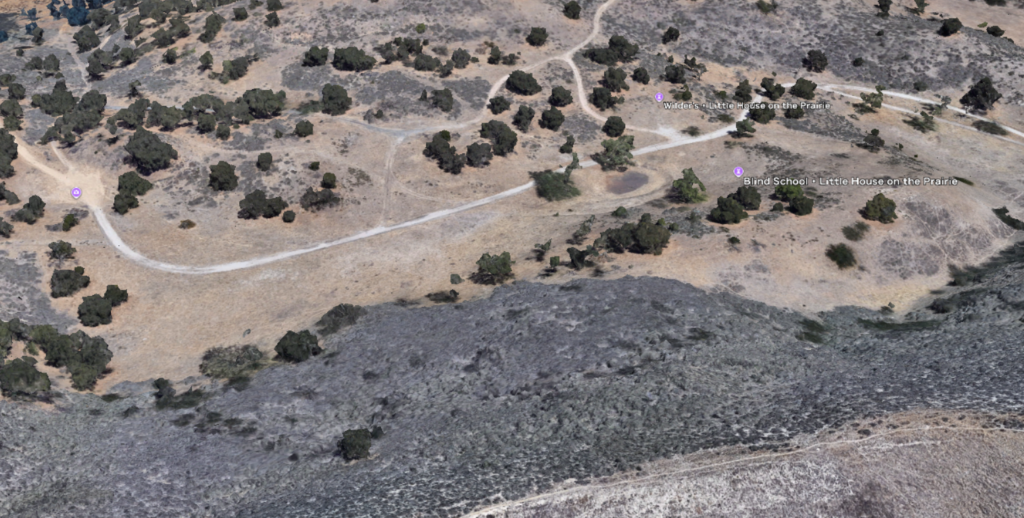
The NBC series had a different set of limitations. Animated characters can cheaply be put into any setting imaginable simply by drawing new backgrounds, but the Ingalls of the NBC show largely stayed put in Plum Creek, which was really Big Sky Movie Ranch, a static TV set northwest of the Los Angeles metro. Big Sky is also a shooting location for Gunsmoke, Father Murphy, and Westworld. TV episodes had to be written in a way that kept the Ingalls largely on that set. That meant most of its episodic narrative content had to be invented as well.
The Little House books in Japan
The Little House books famously made their way to Japan during General Douglas MacArthur’s tenure as Supreme Commander for the Allied Powers (SCAP) during the Allied occupation of Japan after the Potsdam Declaration, the bombings of Hiroshima and Nagasaki, the signing of the Instruments of Surrender, and the drafting of Japan’s postwar constitution. According to Noriko Suzuki’s 2006 paper, Japanese Democratization and the Little House Books1, the recommendation to add The Long Winter to the Allied Forces General Headquarters (GHQ)’s new postwar reading list came from Douglas MacArthur’s wife Jean. However, when I dove into the citations, it seems like this idea about the decision chain starting with Jean MacArthur comes to us from the memory of an uninvolved third party. The Jean MacArthur recommendation is a longstanding oral history account, but I have not found a contemporaneous primary source establishing that Jean MacArthur recommended The Long Winter to the General. From Suzuki’s Footnotes:
For this precious information, I express my sincere gratitude to Ms. Darlys Wynn, assistant director of the Laura Ingalls Wilder Historic Home and Museum in Missouri. According to her, the director of the museum and the president of the Board of Directors, Ms. Jean Coday, remembers hearing that Mrs. MacArthur loved the Little House books and encouraged MacArthur to recommend the series as one of the possible translation books in Japan and Germany.
Regardless, we know for sure from the bookselling industry newspaper Nippon Dokusho Shimbun that The Long Winter made it onto the list of books made allowable for publishers to bid on translating into Japanese. The book was published in 1949 as Nagai Fuyu2 and included this special letter from the author.3
Rocky Ridge Farm
Mansfield, Missouri U.S.A.
July 8, 1948Dear Japanese Children.
Though you are far away and speak a different language, still the things worthwhile in life are the same for us all and the same as when I was a child so long ago. Things of real value do not change with the passing of years nor in going from one country to another. These I am sure you have. It is always best to be honest and truthful; to make the most of what we have; to be happy with simple pleasures, to be cheerful in adversity and have courage in danger.
With love to you all and best wishes for your happiness, I am
Sincerely your friend,Laura Ingalls Wilder

According to the General Headquarters, The Long Winter had a positive reception in Japan, which is now sometimes contested. Little House on the Prairie and Little House in the Big Woods soon followed, but with less fanfare. Cloquet, MN librarian Keiko Satomi took an interview for the first episode of Glynnis MacNicol’s Wilder podcast about her Japanese childhood growing up with the Little House books. According to Satomi, the introduction of the series with The Long Winter, Wilder’s sixth book, was a calculated choice.4 The Long Winter covers what might be the most challenging chapter of the lives of the Ingalls family, during the hard winter in Dakota Territory from 1880 to 1881. Many Japanese laypeople were greatly suffering in the immediate aftermath of the war, due to army and civilian casualties, destruction from firebombing and nuclear attacks, supply shortages, and a harsh winter. For them, The Long Winter may have been a glimpse of hope. Satomi was chosen as a guest for podcast due to writing a critique of Wilder’s dehumanizing depiction of Native Americans.5 The Little House books also point to a spirit of American and democratic exceptionalism that SCAP aimed to promote, with a hint of Rose Wilder Lane‘s “paddle your own canoe” Libertarian ethos.
Rose Wilder Lane, daughter of Laura Ingalls Wilder, was a journalist and author who developed a taste for anti-statist individualism during the emergence of American libertarian thought, later rubbing shoulders with Ayn Rand and Isabel Paterson. During the years in which the Pioneer Girl manuscript, then later as the Little House books were being written and published, Rose acted as something between a handler, editor, and collaborator for her mother. When asked by the publishing industry, she helped her mother rewrite Pioneer Girl into the format of fictional children’s novels. Lane’s outspokenness was largely reactionary to FDR-era New Deal reforms, which rubbed off on her mother, evident in this quote from a 1934 letter to an editor:
The Lord give me patience! How exasperating a bunch of communists in Washington can be! I suppose all we can do is await their pleasure. Give them time enough and they will put us all on the Federal payroll or the relief.6
Impact on Shoujo Manga
In Little House in the Far East: The American Frontier Spirit and Japanese Girls’ Comics, Hisayo Ogushi argues that the Little House books served as one of several Western children’s literature works alongside Anne of Green Gables that had an outsized impact on the development of the aesthetics and tastes of shoujo manga, which is to say comics written for an audience of young girls.7
These early translations of Wilder’s books sowed the seeds of American western idealism, which would later become evident in Japanese girls’ shoujo manga culture.
During the 1970s and 1980s, girls’ culture, often called kawaii (cute) culture, flourished in Japan. With girls’ preference for American country-living styles, it can be argued that the Little House series, along with Anne of Green Gables, had a significant impact on kawaii culture. These characters, along with Laura from the TV show […] offered girls opportunities to be familiar with an American way of living.
Ogushi later cites the impact that Little House on the Prairie had on the narrative underpinnings of the 1979 Nakayoshi manga Mayme Angel, a revenge story set in frontier Oregon during westward expansion. Nakayoshi is a shoujo manga magazine published by print media giant Kodansha which has sold a total of 400 million copies. It has been the home of prominent stories like Sailor Moon, Princess Knight, and Cardcaptor Sakura. Here’s another excerpt.
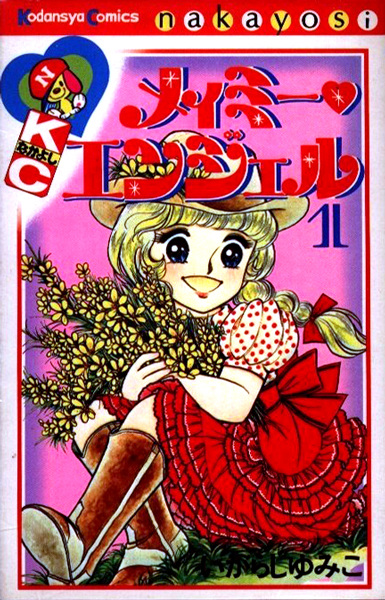
Mixing elements of the Little House series and western movies with revenge plots, Mayme Angel foregrounds a pioneer girl with an independent spirit and feminine agency. During the time when manga which mostly focus on the everyday lives of ordinary girls were at the height of popularity, Mayme Angel presented a girl who followed her own conscience.
For a period of time starting around the Taisho era, stories for young girls written in Japan often focused on family life and fulfilling an expected family role embodied by the state-sanctioned ideology of “Good Wife, Wise Mother”. The postwar allied powers-led democratization program included reforms affecting women’s legal status in Japan. The 1947 Constitution established equality principles in marriage and family law, including property and inheritance, while subsequent Civil Code reforms dismantled elements of the prewar family system. While some Americans today look at the Little House books as a text that upholds traditional family values, perhaps to some Japanese readers, the translation of the adventurous Little House books, starring a tomboyish main character, offered a look at what life could look like for women outside a purely servile role.
Before the late 1960s, shoujo manga was a male-dominated field: during the 1950s and early 1960s, the majority of manga published for girls was created by male artists, many of whom also worked in shounen (boys’) manga. Explorations of what new types of shoujo stories could look like would later be pushed into a new frontier by the famous and incredibly successful Year 24 Group of female shoujo manga authors (referring to Showa 24: most of its cohort were born in 1949 in the Gregorian calendar), which took some influence from the rise of 1970’s Japan’s New Left student protest groups and the global impact of second-wave feminism. The Rose of Versailles is a prime example of their creative output: a fictional romance set in revolutionary France between Marie Antoinette and the invented Oscar François de Jarjayes. The Year 24 Group then became influential, not because women had never made shoujo manga before them, but because their success coincided with and helped drive a major expansion of the genre’s thematic and formal possibilities. In the decades that followed, shoujo manga authorship shifted to being predominantly female.
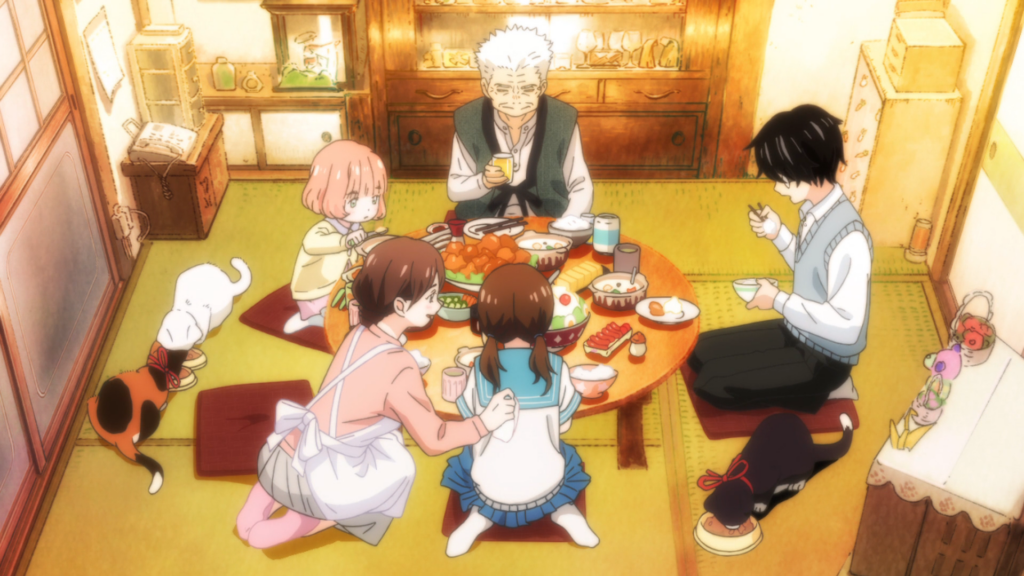
For an interview in the July 2019 issue of Moe magazine, manga author and illustrator Chica Umino (Honey and Clover, March Comes In Like a Lion) directly mentioned obsessing over Anne of Green Gables and the Little House books in her childhood. In the warmest chapters of the often dark and introspective March Comes In like a Lion, Umino obsesses over beautifully depicting the joy shared through a family comfort meal, during which aspects of Wilder’s approach to prose shine through. “Because I read these scenes so passionately, I thought having meal scenes in my own manga would make it more fun for the readers.”8
Laura on TV in Japan
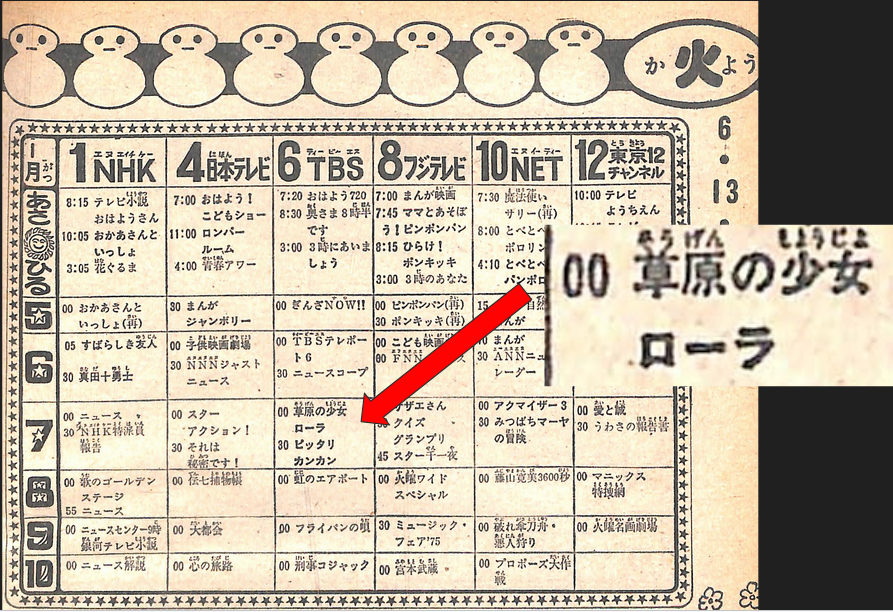
The impact of Sougen no Shoujo Laura was rather minimal in terms of popularizing the Little House books in Japan, but the NHK run of the NBC series was a major hit. The anime was broadcast on TBS [Tokyo Broascasting System] at 7 PM and according to some third-party sources had a pretty limited viewership, unlike the more popular World Masterpiece Theater (WMT) shows that would move to NHK. As a side effect, it usually doesn’t get the same level of attention as series produced within WMT when it comes to new merchandise and artwork, further hampered by the series’ licensing hell. After the NBC series became incredibly popular, any promotion for Sougen no Shoujo Laura has been on thin ice. Aside from a mention on the Nippon Animation website, it has never gotten any new content or physical Japanese-language releases. It is because of that legal limbo that I recommend viewing the series in via unofficial means.
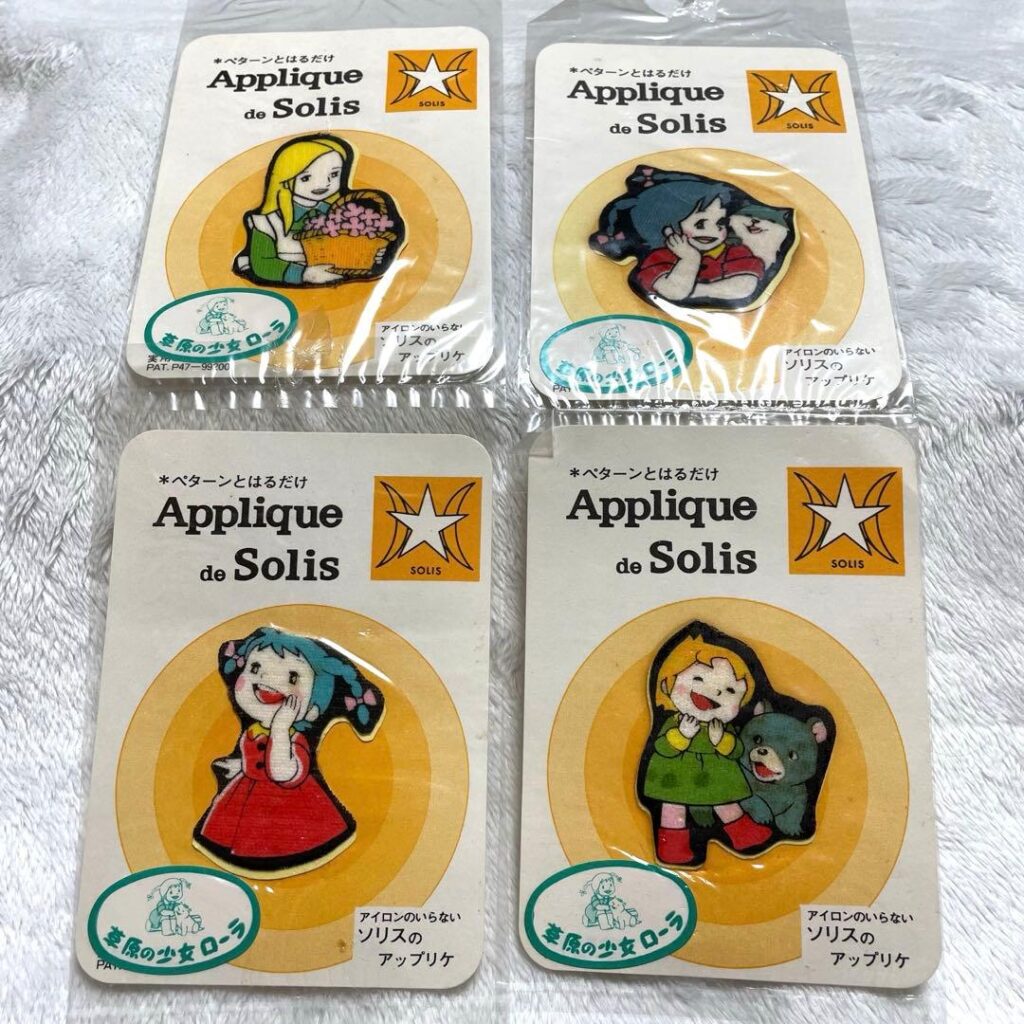
There was some merchandise produced immediately after release, much of which is similar to that produced for other anime of the time, and especially other Nippon Animation works. I have a few ‘grails’ I would love to get a hold of, namely any decent animation cel and a series of heat transfer adhesive appliques. A sewing-adjacent product just feels a bit thematically on-the-nose.
A line of overlay text that appears in the opening indicates that Laura, the Prairie Girl was recommended by the Central Council for Child Welfare, a gesture intended to distinguish media that was high-quality and appropriate for children, a bit like the E/I symbol. The Central Council for Child Welfare was a public sector advisory body under Japan’s Ministry of Health and Welfare. This award is mentioned on the Nippon Animation site.9
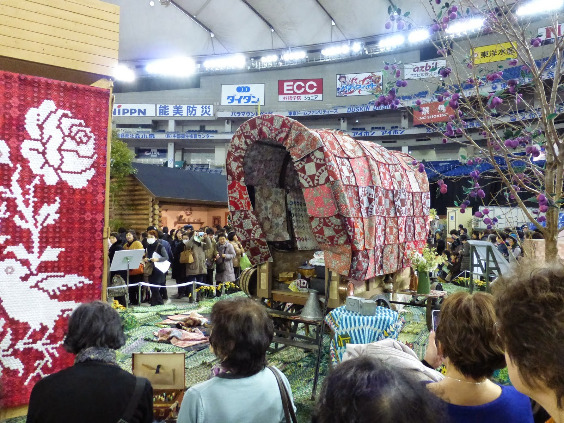
According to an article from The Economist, the popularity of the NHK broadcast of the Little House on The Prairie NBC series popularized quilting as a hobby in Japan, which was first introduced by a segment of the Japanese diaspora who returned to their home country after the end of World War II.10 Japan is now home to several quilting shows, one of which in 2015 housed a special Little House themed exhibit, with a quilted covered wagon and a homestead laden with quilts.11
Nippon Animation Staff
Across various English web sources (Anime News Network, Wikipedia, AniDB, etc.), cast information for Sougen no Shoujo Laura is not always consistent when it comes to name order and picking kanji readings. I think this is a list of names I can stand behind.
Series Composition: Yamazaki Iwao
Writers: Masao Maruyama, Yamazaki Iwao
Directors: Mitsuo Ezaki
Producers: Inoue Hiroshi, Junzou Nakajima, Tadakuma Masashi
Character Design: Mori Yasuji
Animation Lead: Endou Masaharu
Music: Kawaguchi Makoto, Akihiko Takashima, Kumiko Oosugi
Writer Masao Maruyama went on to be a prolific producer and a cofounder of the famous studio Madhouse. Mori Yasuji Started out at Toei Douga before moving to Nippon Animation. At Toei, he worked on Hakujaden and Animal Treasure Island. At Nippon Animation, Yasuji was a Key Animator for Heidi and Future Boy Conan alongside Hayao Miyazaki and others. Later in life he became a notable children’s book illustrator. Junzou Nakajima was a Nippon Animation regular. Nakajima worked on many WMT shows and has credits with Nippon until at least 2010.
Kumiko Oosugi recorded a great deal of anime music, especially for Nippon Animation. She has been called one of the “Four Heavenly Kings” of Anisong. Her most famous performances were on openings for Doraemon and Attack No. 1. When I checked, The Laura opening was listed on Spotify as part of a collection showcasing Oosugi’s discography, but the track is greyed out, deeming it unplayable.
Okuyama Reiko, Natsuzora, and ‘Sora‘
In 2019, NHK started broadcasting a series called Natsuzora, becoming the channel’s 100th entry in the history of the ‘Asadora‘ lineup. Renzoku Terebi Shousetsu, or more colloquially Asadora, [lit. morning drama], is a 15 minute broadcast produced by NHK that airs in the morning, which first started in 1961. Most Asadora stories follow a determined female protagonist overcoming hardships and growing into their own over many years.
Natsuzora is a historical fiction retelling of the life of animator Okuyama Reiko, one of the first key Japanese woman animators, who had important positions on productions at Toei like Hakujaden and Sarutobi Sasuke while experiencing workplace discrimination. Reiko had a stint at Nippon Animation after leaving Toei, but did not work on Sougen no Shoujo Laura.
Regardless, Laura gets the ‘WcDonalds‘ treatment in Natsuzora, and we see the fictional version of Reiko working on ‘Daisougen no Shoujo Sora‘, whose setting has been moved from the Midwestern United States to the northern Japanese island of Hokkaido, where Reiko spent her childhood in the first arc of the drama. The Little House books are mentioned by name. The Ghibli Wiki misattributes this as a Heidi sendup, possibly due to a mistranslation.12 Many Hokkaido settings filmed in Natsuzora are now fan tourist destinations in their own right.
Dubbing
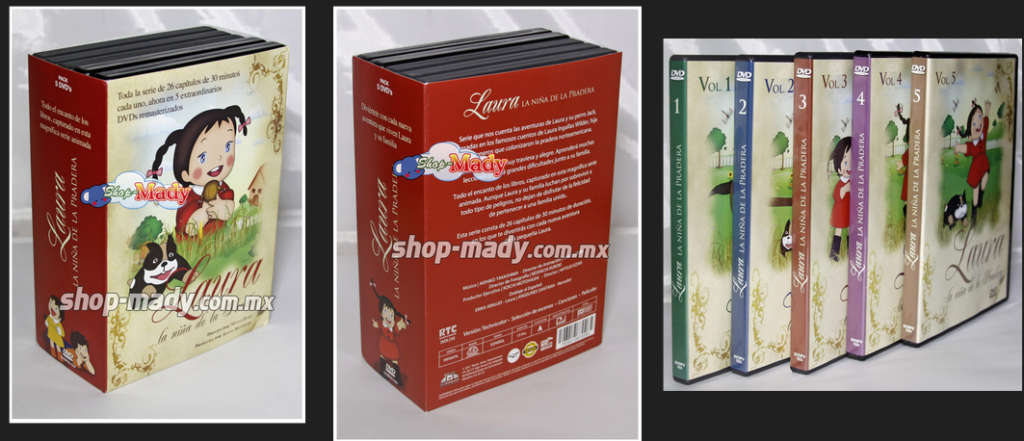
The Laura anime was never released in English, but it did have three dubs. The 1982 Spanish dub, Laura la Niña de la Pradera, seems to have been fairly popular.
It got a DVD release, which is still sometimes for resale. You can probably find a rip of this dub on YouTube in rather poor quality, and some episodes may be out of order. I feel that the quality of the Spanish voice acting here leaves a bit to be desired. Per ANN, this version aired in Mexico, Spain, Colombia, and Peru.
The Italian dub had a completely original opening theme song, “Laura”, which was sung by Cristina D’Avena and used a unique re-cut of episode clips for visuals. D’Avena also sang for the Italian dubs of the Studio Pierrot magical idol anime shows from the 80’s: Creamy Mami, Persia, and Magical Eri, which were all big hits in Italy. In Italy, Laura first aired March 1982 on Canale 5.
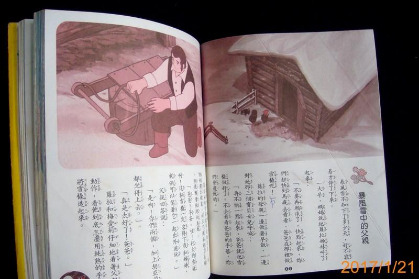
As far as I can tell, The Mandarin dub, 彩虹妹妹 [Cǎihóng Mèimei, lit. Rainbow Sister], was produced for TTV and was aired in Taiwan only in 1977 and rebroadcast in 1983.13 It has not survived, but I found some auction listings for kids’ books in Mandarin with art from the anime. There is very little English documentation about this version and I have almost zero experience with translating Mandarin Chinese, so I am skeptical about making too many declarative statements.
Pepin, WI LIW Museum Pieces
Sougen no Shoujo Laura quickly became a special interest for me. After I started researching anime tourism, I became interested in visiting its historic sites. Later I became motivated by the idea of providing articles and goods produced for the anime to museums at the historic sites by making purchases through an auction proxy. I was able to get my hands on an episode script, a 45 RPM single of the opening and ending theme, and a book of character design illustrations.
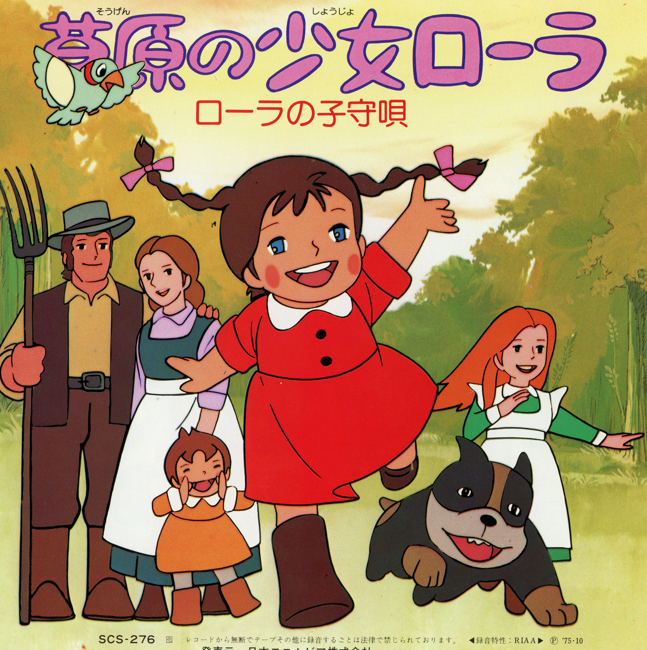
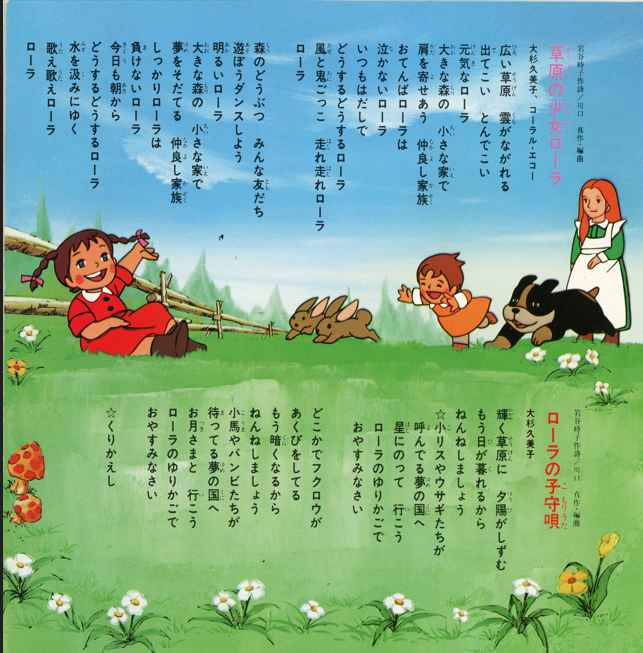
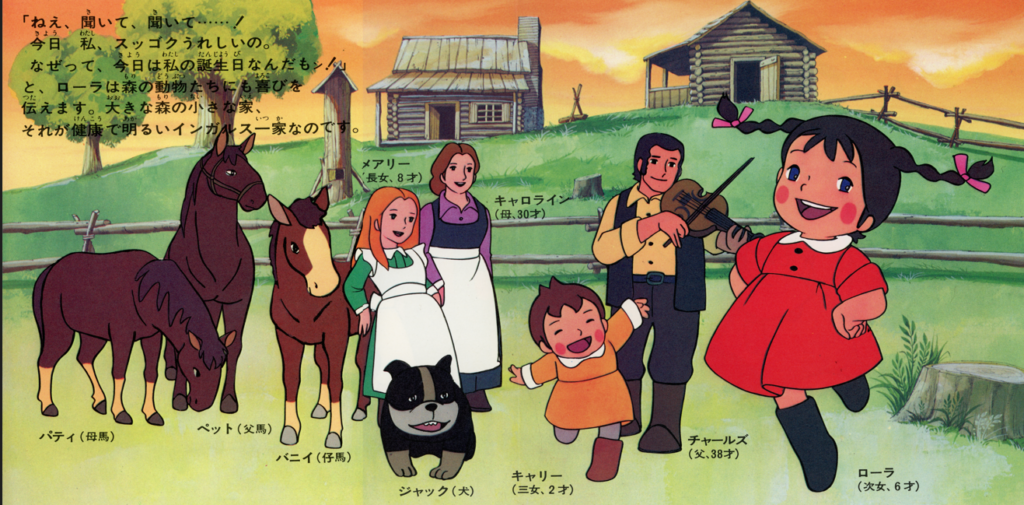
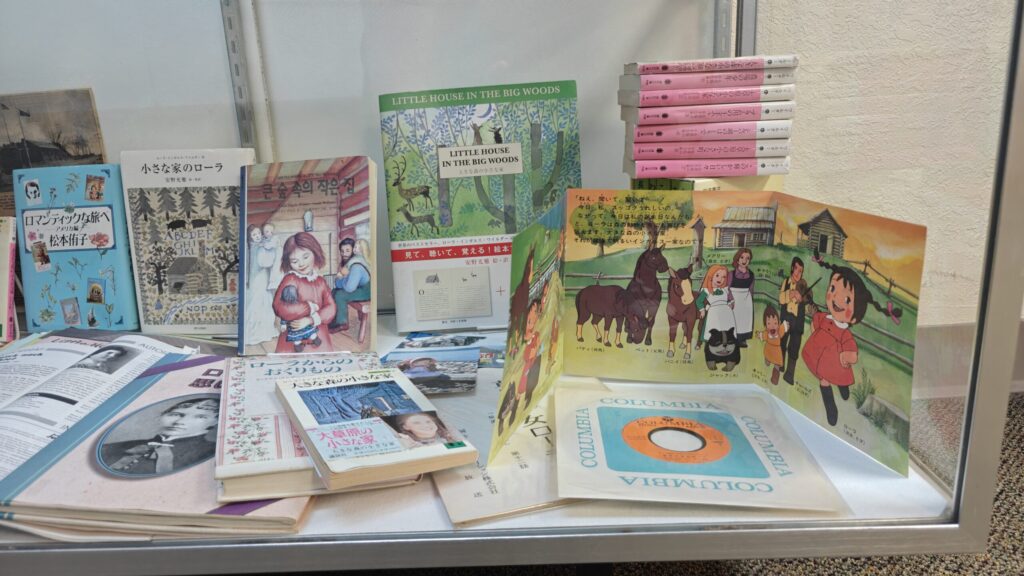
First off, the 45 RPM record. It’s a standard 7-inch single with the opening and ending songs for the Laura, The Prairie Girl. It was pressed and published by Nippon Columbia Co., Ltd. The sound recording copyright date on the front of the sleeve is October 1975. The sleeve also has Japanese lyrics and a 3-page spread introducing the cast. According to a sticker, It was recorded in stereo and would have retailed for ¥500 Yen at MSRP, which inflation-adjusted to 2026 is about ¥1058, or $6.67. The vocals on both songs were performed by Kumiko Ousugi 大杉久美子, better known in Japan as a vocalist for Attack No. 1, Aim for the Ace, and Doraemon.
The opening theme is titled after the series. The more somber ending theme has the title「ローラの子守唄」”Laura no Komoriuta”, or “Laura’s Lullaby”. I think it’s a bit cute that a literal reading of the characters that make up komoriuta [子守唄] is “child-guard/protect-song”. I have included links to videos of the opening and ending and a text version of their lyrics at the end of this article.
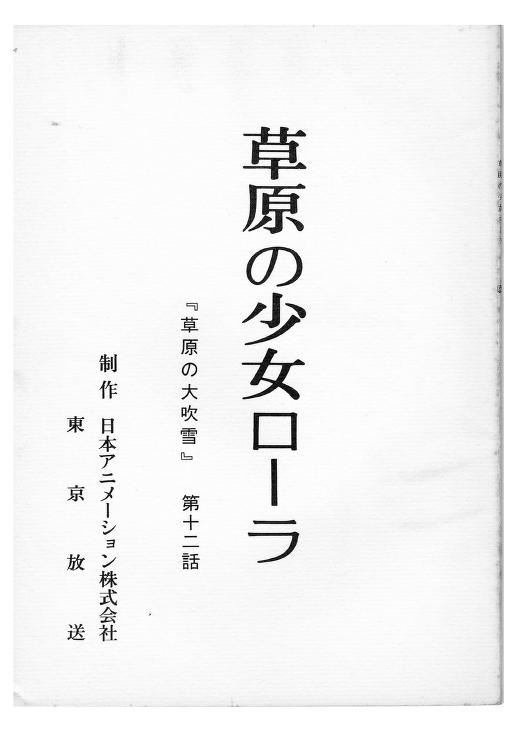
Next up, the episode script. It’s about 10×7 inches and about 50 pages. The cover of the script and the setting illustration book are both yellowed printer paper, although the weight is a bit heavier than the pages inside. The script I obtained is for the 12th episode of the anime, which tells a slightly modified version of Christmas morning in the Pepin house.
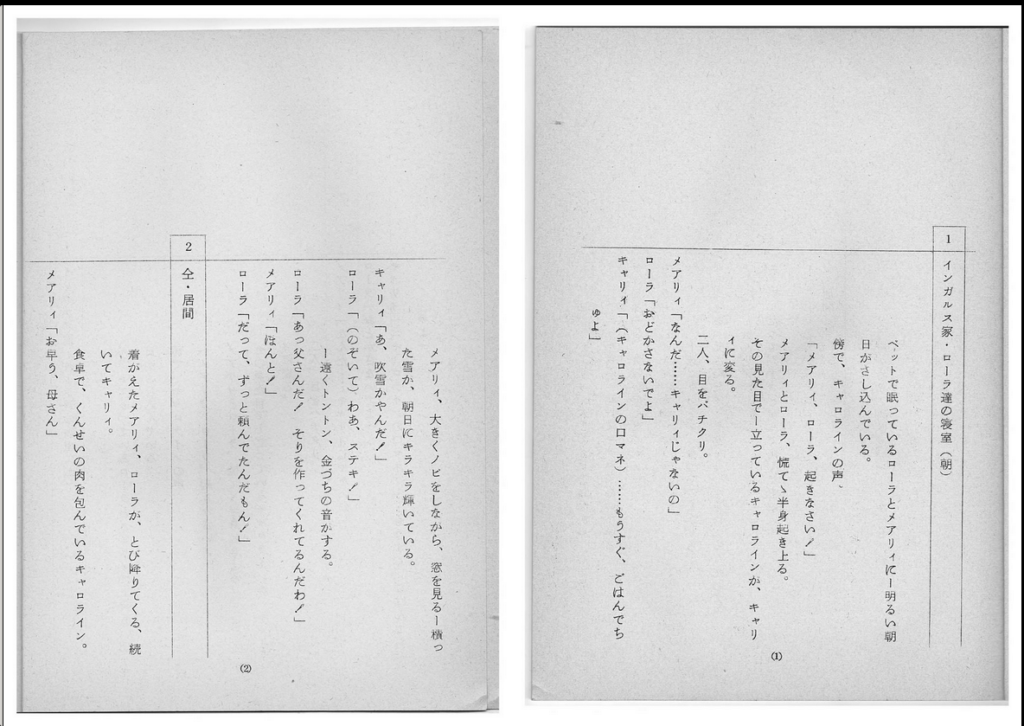
A typical page spread looks like this [below]. You might notice that the text is oriented vertically. These lines are intended read top to bottom, and then right to left. If you look on the top of the lines after the scene is introduced, you can see the names of which actors are speaking before the hook brackets 「 」signify a character’s spoken line. Since the Ingalls family have Western names, their names are written in katakana, a subset of Japanese writing symbols used for loanwords. メアリー is Mary, ローラ is Laura, and キャリイis Carrie.
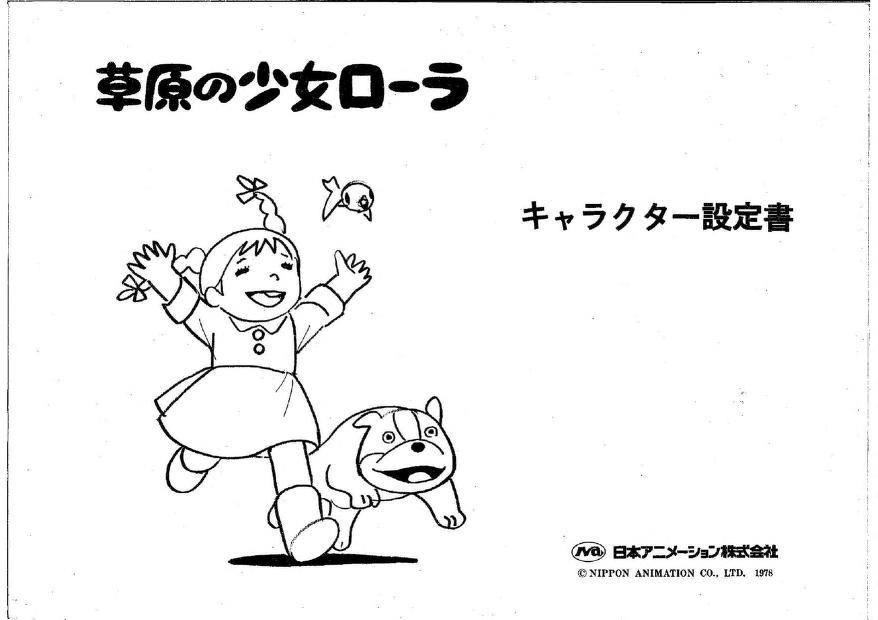
The illustrated character reference book, or settei (設定) book, is about 17 pages long. The dimensions are about 14 by 10.5 inches, quite a bit larger than standard American letter or legal paper. Reference sheets are distributed during production so that the different teams of animators have the same reference point for drawing everything that needs to be in the show.
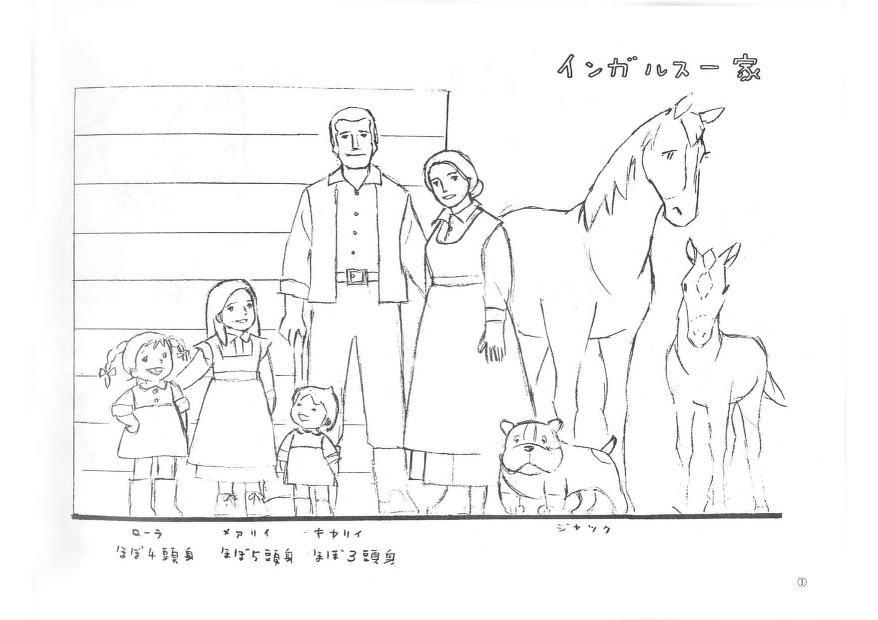
This particular reference sheet booklet contains drawings of the cast and the most important animals, Jack the family dog and the horse team. Page spreads of each character present their faces and bodies at a number of different standard angles. My favorite pick from these sheets is this height comparison of the core Ingalls family.
It’s important to point out that settei are photocopies that are used, reused, and even re-copied all throughout production. While key art, backgrounds, traditional cels, and inbetweens require unique pencil drawings or paintings by individual animators, settei are created first, as reference material, and their copies, like the one obtained for the museum, are not one of one. In fact, given that this reference book is dated to 1978, it was likely printed after the anime aired, possibly for the sake of design consistency while subcontracting the production of official merchandise.
After some correspondence with a museum curator, I was able to supply these items to the Laura Ingalls Wilder Museum in Pepin, Wisconsin. On a later visit I was able to see the record I donated on display.
Visiting Pepin
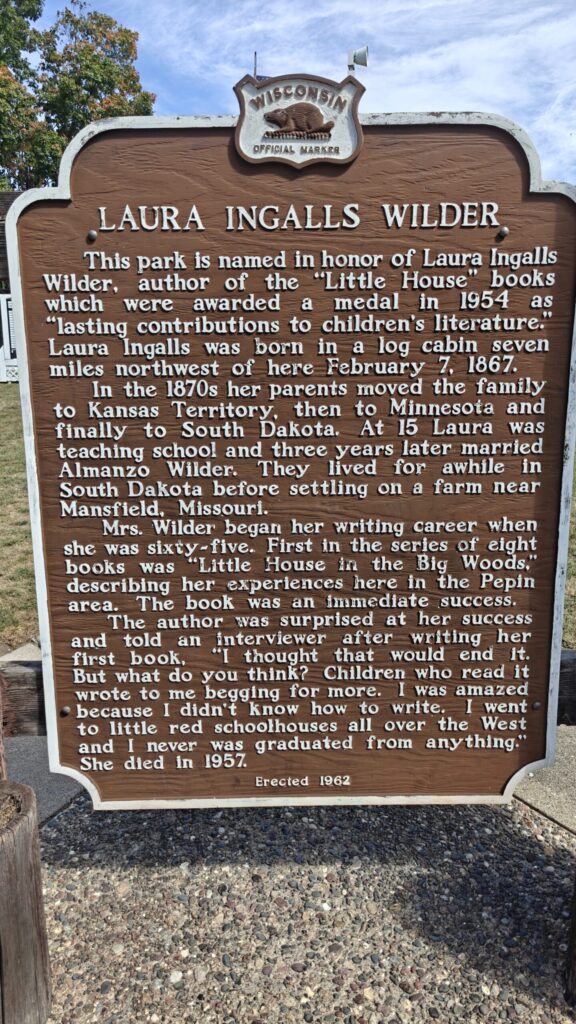
Every year, Pepin, Wisconsin is the site of an event called Laura Days. Themed cultural festivals with similar naming conventions are a common occurrence in small Midwestern towns. For Pepin, this weekend event is themed around the city’s history as the birthplace and first home of Laura Ingalls Wilder. In past years, actors from the NBC series have made guest appearances.
This year, I was able to deliver a presentation about the anime in the Pepin museum on the night before the proper start of the festival. My audience consisted of some Laura enthusiasts and museum regulars, who were enough to fill all the chairs available in a little side room. At least two listeners had some familiarity with anime. I also included some details about Araiguma Rascal. The turnout really impressed me. I also stayed for the rest of the event.

On the first day I participated in a 5K Run/Walk, had some pie, and walked through live demonstrations of blacksmithing, spinning and dyeing wool, rope-making, and flint sharpening. All the craftspeople were set up under old-fashioned fabric tents and wore historic dress. On the main stage, I watched a fiddling competition, a spelling bee, and a Laura lookalike pageant.
The next day of the festival, Sunday, started out with a pancake breakfast and a Bluegrass-themed worship service. On both days, the nearby replica Wayside Cabin was home to some historical reenactments and yard games, with a shuttle bus available. The afternoon simmered down after a small hometown parade. I left Pepin with a full stomach and a full heart.
Sources
- https://doi.org/10.1353/chq.2006.0031 ↩︎
- https://www.library.metro.tokyo.lg.jp/junior/puratanasu/47/contents02/index.html ↩︎
- https://web.archive.org/web/20240618143801/https://time.com/4234438/letter-laura-ingalls-wilder-2/ ↩︎
- https://omny.fm/shows/wilder/e1-now-is-now ↩︎
- https://www.pineknotnews.com/story/2019/11/22/opinion/at-the-library-libraries-put-little-house-series-in-new-light/2229.html ↩︎
- https://www.pbs.org/wnet/americanmasters/the-subtle-libertarian-politics-of-laura-ingalls-wilders-little-house-books/16584/ ↩︎
- https://www.jaas.gr.jp/jjas/pdf/2016/02_OGUSHI.pdf ↩︎
- http://takara-bako.com/index.php/tag/little-house-on-the-prairie/ ↩︎
- https://www.nippon-animation.co.jp/corp/prize/ ↩︎
- https://www.economist.com/united-states/2024/05/02/a-surprising-japanese-presence-in-a-traditional-american-craft ↩︎
- https://susanbriscoe.blogspot.com/2015/01/tokyo-great-international-quilt-show_28.html ↩︎
- https://ghibli.fandom.com/wiki/Natsuzora ↩︎
- https://www.facebook.com/share/v/1CMPKLcqRL/ ↩︎